The valid version of this policy is published on the Polestar intranet. Print-outs may be out of date – always check the intranet for latest version. Polestar Legal is responsible for publishing it on the Polestar intranet. The original language of this document is English. Policy — Insider trading Type Corporate Policy Scope Global (Polestar Automotive Holding UK PLC and all subsidiaries) Owner Lisa Edblom, Head of Corporate Legal Version Effective date 2.0 2023-04-05 Approved by Last review Board of Directors 2023-03-29 2023-03-29 What’s new since last version Updated SpeakUp reference
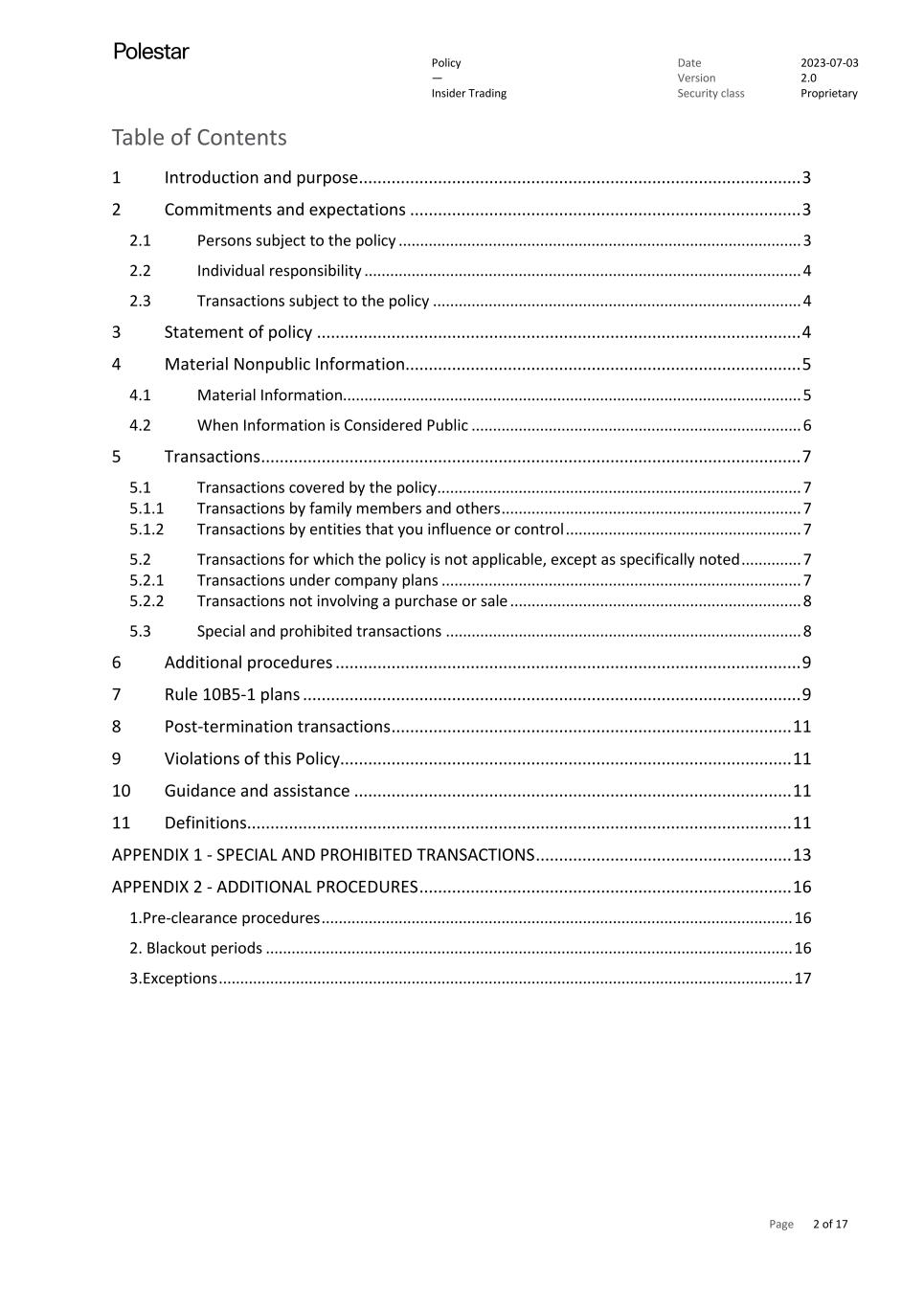
Policy Date 2023-07-03 — Version 2.0 Insider Trading Security class Proprietary Page 2 of 17 Table of Contents 1 Introduction and purpose ............................................................................................... 3 2 Commitments and expectations .................................................................................... 3 2.1 Persons subject to the policy .............................................................................................. 3 2.2 Individual responsibility ...................................................................................................... 4 2.3 Transactions subject to the policy ...................................................................................... 4 3 Statement of policy ........................................................................................................ 4 4 Material Nonpublic Information..................................................................................... 5 4.1 Material Information........................................................................................................... 5 4.2 When Information is Considered Public ............................................................................. 6 5 Transactions .................................................................................................................... 7 5.1 Transactions covered by the policy ..................................................................................... 7 5.1.1 Transactions by family members and others ...................................................................... 7 5.1.2 Transactions by entities that you influence or control ....................................................... 7 5.2 Transactions for which the policy is not applicable, except as specifically noted .............. 7 5.2.1 Transactions under company plans .................................................................................... 7 5.2.2 Transactions not involving a purchase or sale .................................................................... 8 5.3 Special and prohibited transactions ................................................................................... 8 6 Additional procedures .................................................................................................... 9 7 Rule 10B5-1 plans ........................................................................................................... 9 8 Post-termination transactions ...................................................................................... 11 9 Violations of this Policy ................................................................................................. 11 10 Guidance and assistance .............................................................................................. 11 11 Definitions ..................................................................................................................... 11 APPENDIX 1 - SPECIAL AND PROHIBITED TRANSACTIONS ....................................................... 13 APPENDIX 2 - ADDITIONAL PROCEDURES ................................................................................ 16 1.Pre-clearance procedures .............................................................................................................. 16 2. Blackout periods ........................................................................................................................... 16 3.Exceptions ...................................................................................................................................... 17
Policy Date 2023-07-03 — Version 2.0 Insider Trading Security class Proprietary Page 3 of 17 1 Introduction and purpose Polestar Automotive Holding UK PLC has securities listed and traded on the Nasdaq Stock Exchange (the “Securities”). As a consequence, Polestar undertakes to follow certain specific rules and regulations applicable to companies with listed securities. This Policy is intended to ensure Polestar and Polestar employees comply with laws prohibiting insider trading. All employees are required to understand and adhere to this Policy, and it is of even greater importance that those employees who face higher risk of access to Inside Information (as defined below) strictly follow the principles described herein. Employees are also expected to keep up to date with the latest version of this Policy. This Policy should be read in conjunction with Polestar’s Code of Conduct, Confidentiality Policy, Fair Disclosure Directive, Communication Policy and Social Media Directive. The Insider Trading Policy (the “Policy”) provides guidelines with respect to transactions in the securities of Polestar Automotive Holding UK PLC and the handling of confidential information about Polestar and the companies with which Polestar does business. Polestar Automotive Holding UK PLC Board of Directors (the “Board”) has adopted this Policy to ensure compliance with U.S. federal, U.S. state and foreign securities laws that prohibit certain persons who are aware of Material Nonpublic Information (“MNPI”) about a company from: (i) trading in securities of that company; or (ii) providing Material Nonpublic Information to other persons who may trade on the basis of that information (Rule 10b-5) Regulators, including the U.S. Securities and Exchange Commission (“SEC”) and the Financial Industry Regulatory Authority, have adopted sophisticated surveillance techniques to identify insider trading transactions, and it is important to Polestar to avoid even the appearance of impropriety. 2 Commitments and expectations 2.1 Persons subject to the policy The Policy applies to all employees of Polestar, including directors. All Polestar’s employees, regardless of function, position or location, whether working full-time or part-time, under a permanent contract or on a temporary basis, are subject to this Policy. In addition, consultants and agency personnel who work at Polestar premises or under the direction of Polestar (who usually have a Polestar identification – or PDFID – and/or a @polestar.com email address). Note that this Policy shall not be construed as an employment contract and does not give consultants or agency personnel any right to continued employment by Polestar or its subsidiaries
Policy Date 2023-07-03 — Version 2.0 Insider Trading Security class Proprietary Page 4 of 17 Polestar reserves the right to determine the other persons who should be subject to this Policy, such as other contractors or consultants who have access to Material Nonpublic Information. This Policy also applies to family members, other members of a person’s household and entities controlled by a person covered by this Policy, as described below. 2.2 Individual responsibility Persons subject to the Policy have ethical and legal obligation to maintain the confidentiality of information about Polestar and not to engage in transactions in Polestar Securities while in possession of Material Nonpublic Information. Each individual is responsible for their compliance with this Policy, and that any family member, household member or entity whose transactions are subject to the Policy, as discussed below, also comply with the Policy. In all cases, the responsibility for determining whether an individual is in possession of MNPI rests with that individual, and any action on the part of Polestar, the General Counsel or any other employee or director pursuant to the Policy (or otherwise) does not in any way constitute legal advice or insulate an individual from liability under applicable securities laws. You could be subject to severe legal penalties and disciplinary action by Polestar for any conduct prohibited by the Policy or applicable securities laws, as described below in more detail under the heading “Consequences of violations of this Policy”. 2.3 Transactions subject to the policy The Policy applies to transactions in Polestar’s securities (collectively referred to as “Polestar Securities”), including Polestar’s ordinary shares, options to purchase ordinary shares, warrants, or any other type of securities that Polestar may issue, including (but not limited to) preferred stock and convertible notes, as well as depositary and derivative securities that are not issued by Polestar, such as American depositary shares or receipts with respect to Polestar’s ordinary shares or warrants, exchange-traded put or call options or swaps relating to Polestar Securities. 3 Statement of policy It is the policy of Polestar that no employee (including directors) of Polestar (or any other person designated by this Policy or by Polestar’s General Counsel as subject to the Policy) who is aware of MNPI relating to Polestar may, directly, or indirectly through family members or other persons or entities: - Engage in transactions in Polestar Securities, except as otherwise specified in this Policy under the headings “Transactions Under Company Plans,” “Transactions Not Involving a Purchase or Sale” and “Rule 10b5-1 Plans”; - Recommend the purchase or sale of any Polestar Securities; - Disclose Material Nonpublic Information to persons within Polestar whose jobs do not require them to have that information, or outside of Polestar to other persons, including, but not limited to, family, friends, business associates, investors and expert consulting firms, unless any such disclosure is made in accordance with Polestar’s policies regarding the protection or authorized external disclosure of information regarding Polestar; or
Policy Date 2023-07-03 — Version 2.0 Insider Trading Security class Proprietary Page 5 of 17 - Assist anyone engaged in the above activities. In addition, it is the policy of Polestar that no director, or other employee of Polestar (or any other person designated as subject to this Policy) who, in the course of working for Polestar, learns of Material Nonpublic Information about a company with which Polestar does business, including a customer or supplier of Polestar, may trade in that company’s securities until the information becomes public or is no longer material. There are no exceptions to this Policy, except as specifically noted herein. Transactions that may be necessary or justifiable for independent reasons (such as the need to raise money for an emergency expenditure), or small transactions, are not excepted from this Policy. The securities laws do not recognize any mitigating circumstances, and, in any event, even the appearance of an improper transaction must be avoided to preserve Polestar’s reputation for adhering to the highest standards of conduct as a listed company. 4 Material Nonpublic Information “Material Nonpublic Information” (or “MNPI”) is also known as “inside information” in some jurisdictions. If you are unsure whether information is material, or whether it is public (widely disseminated), you should: (a) Consult with Legal before making any decision to disclose such information (other than to persons who need to know it) or to trade in or recommend securities to which that information relates, or (b) Assume that the information is material and nonpublic. 4.1 Material Information Information is considered “material” if a reasonable investor would consider that information important in making a decision to buy, hold or sell securities. Any information that could be expected to affect a company’s securities price, whether it is positive or negative, should be considered material. There is no specific standard for assessing materiality – materiality is based on an assessment of all of the facts and circumstances, and is often evaluated by enforcement authorities retrospectively. Possible material information or events include, but are not limited to: • Projections of future earnings or losses, or other earnings guidance; • Changes to previously announced earnings guidance, or the decision to suspend earnings guidance; • A pending or proposed merger, acquisition or tender offer;
Policy Date 2023-07-03 — Version 2.0 Insider Trading Security class Proprietary Page 6 of 17 • A pending or proposed acquisition or disposition of a significant asset; • A pending or proposed joint venture; • A company restructuring; • Material related party transactions; • A change in dividend policy, the declaration of a stock split, or an offering of additional securities; • Bank borrowings or other financing transactions out of the ordinary course; • The establishment of a repurchase program for Polestar Securities; • A change in Polestar’s pricing or cost structure; • Major marketing changes; • Management changes; • Board of Directors changes; • A change in auditors or notification that the auditor’s reports may no longer be relied upon; • Development of a significant new product, process, or service; • Pending or threatened significant litigation, or the resolution of such litigation; • Regulatory approvals or changes in regulations and any analysis of how they affect Polestar; • Impending bankruptcy or the existence of liquidity problems; • Significant cybersecurity incidents; and • The imposition of a ban on trading in Polestar Securities or the securities of another company. 4.2 When Information is Considered Public Information that has not been disclosed to the public is generally considered to be nonpublic information. In order to establish that the information has been disclosed to the public, it is necessary to demonstrate that the information has been widely disseminated. This is a fact-specific analysis: - Information generally would be considered widely disseminated if it has been disclosed through the broad-based newswire services, a broadcast on widely-available radio or television programs, publication in a widely-available newspaper, magazine or news website, and is accompanied by public disclosure documents filed with the SEC that are available on the SEC’s website. By contrast, information would likely not be considered widely disseminated if it is available only to Polestar’s employees, only posted on Polestar’s social
Policy Date 2023-07-03 — Version 2.0 Insider Trading Security class Proprietary Page 7 of 17 media accounts, or only available to a select group of analysts, brokers and institutional investors. - Once information is widely disseminated, it is still necessary to afford the investing public with sufficient time to absorb the information. As a general rule, information should not be considered fully absorbed by the marketplace until after the first business day after the day on which the information is released. If, for example, Polestar was to make an announcement on a Monday, you should not trade in Polestar Securities until Wednesday. Depending on the particular circumstances, Polestar may determine that a longer or shorter period should apply to the release of specific Material Nonpublic Information. 5 Transactions 5.1 Transactions covered by the Policy 5.1.1 Transactions by family members and others This Policy applies to family members who reside with an employee (including a spouse, a child, stepchildren, grandchildren, parents, stepparents, grandparents, siblings and in-laws), anyone else who lives in your household, and any family members who do not live in your household but whose transactions in Polestar Securities are directed by you or are subject to your influence or control, such as parents or children who consult with you regarding Polestar or Polestar Securities before they trade in Polestar Securities (collectively referred to as “Family Members”). You are responsible for the transactions of these other persons and therefore should make them aware of the need to alert you before they trade in Polestar Securities, so that you can ensure that such trade is handled in accordance with this Policy, and you should treat all such transactions for the purposes of this Policy and applicable securities laws as if the transactions were for your own account. The Policy does not, however, apply to personal securities transactions of Family Members where the purchase or sale decision is made by a third party not controlled by, influenced by or related to you or your Family Members. 5.1.2 Transactions by entities that you influence or control The Policy applies to any entities that you influence or control, including any corporations, partnerships or trusts (collectively referred to as “Controlled Entities”), and transactions by these Controlled Entities should be treated for the purposes of this Policy and applicable securities laws as if they were for your own account. 5.2 Transactions for which the policy is not applicable, except as specifically noted 5.2.1 Transactions under company plans The Policy does not apply in the case of the following transactions, except as specifically noted: 1. Stock Option Exercises: This Policy does not apply to the exercise of an employee stock option acquired pursuant to Polestar’s plans, or to the exercise of a tax withholding right pursuant to
Policy Date 2023-07-03 — Version 2.0 Insider Trading Security class Proprietary Page 8 of 17 which a person has elected to have Polestar withhold shares subject to an option to satisfy tax withholding requirements. This Policy does apply, however, to any sale of stock as part of a broker-assisted cashless exercise of an option, or any other market sale for the purpose of generating the cash needed to pay the exercise price of an option. 2. Restricted Share Awards: This Policy does not apply to the vesting of restricted shares, or the exercise of a tax withholding right pursuant to which you elect to have Polestar withhold shares to satisfy tax withholding requirements upon the vesting of any restricted shares. The Policy does apply, however, to any market sale of restricted shares. 3. Employee Share Purchase Plan: This Policy does not apply to purchases of Polestar Securities in the employee share purchase plan resulting from your periodic or lump sum contribution of money to the plan pursuant to the election you made at the time of your enrolment in the plan. This Policy does apply, however, to your initial election to participate in the plan, changes to your election to participate in the plan for any enrolment period, and to your sales of Polestar Securities purchased pursuant to the plan. 4. Dividend Reinvestment Plan: This Policy does not apply to purchases of Polestar Securities under any dividend reinvestment plan Polestar adopts resulting from your reinvestment of dividends paid on Polestar Securities. This Policy does apply, however, to voluntary purchases of Polestar Securities resulting from additional contributions you choose to make to the dividend reinvestment plan, and to your election to participate in the plan or increase your level of participation in the plan. This Policy also applies to your sale of any Polestar Securities purchased pursuant to the plan. 5.2.2 Transactions not involving a purchase or sale Bona fide gifts are not transactions subject to this Policy, unless the person making the gift has reason to believe that the recipient intends to sell the Polestar Securities while the employee or director is aware of Material Nonpublic Information, or the person making the gift is subject to the trading restrictions specified below in Section 7 “Pre-Clearance and Blackouts” and the sales by the recipient of the Polestar Securities occur during a blackout period. Further, transactions in mutual funds that are invested in Polestar Securities are not transactions subject to this Policy. 5.3 Special and prohibited transactions Polestar has determined that there is a heightened legal risk and/or the appearance of improper or inappropriate conduct if the persons subject to this Policy engage in certain types of transactions. It therefore is Polestar’s policy that any persons covered by this Policy may not engage in, or should otherwise consider Polestar’s preferences regarding the following transactions: • Short-Term Trading • Short Sales • Publicly-Traded Options • Hedging Transactions • Margin Accounts and Pledged Securities
Policy Date 2023-07-03 — Version 2.0 Insider Trading Security class Proprietary Page 9 of 17 • Standing and Limit Orders Definitions and detailed rules for special and prohibited transactions are provided in Appendix 1. 6 Additional procedures Polestar has established additional procedures in order to assist Polestar in the administration of this Policy, to facilitate compliance with laws prohibiting insider trading while in possession of Material Nonpublic Information, and to avoid the appearance of any impropriety. These additional procedures are applicable only to those individuals described and consist of: Pre-clearance from Polestar General Counsel: certain employees who, because of the nature of their job, are routinely in possession of Material Nonpublic Information (designated as “Covered Persons”) may not engage in any transaction in Polestar Securities without first obtaining pre- clearance of the transaction from the General Counsel. Blackout periods (Quarterly and Event specific Blackout): Covered Persons and other employees being in possession of ad-hoc Event specific material information persons are subject to quarterly trading restrictions and event-driven trading restrictions and may not conduct any transactions involving Polestar’s Securities during “Blackout Periods”. These additional procedures are described in Appendix 2. 7 Rule 10B5-1 plans Rule 10b5-1 under the U.S. Securities Exchange Act of 1934, as amended, provides an affirmative defense to insider trading liability under Rule 10b-5. In order to be eligible to rely on this defense, a person subject to this Policy must enter into a Rule 10b5-1 plan for transactions in Polestar Securities that meets certain conditions specified in Rule 105b-1 (a “Rule 10b5-1 Plan”). If the Rule 10b5-1 Plan meets the necessary legal requirements and was adopted following the procedures described in this Policy, Polestar Securities may be purchased or sold without regard to certain insider trading restrictions. Generally, a compliant Rule 10b5-1 Plan must: 1. be in writing and signed by the person adopting the Rule 10b5-1 Plan; 2. be entered into within a Window Period, and the Rule 10b5-1 Plan may only be modified or terminated when there is no quarterly, special or other blackout in effect with respect to the person modifying the Rule 10b5-1 Plan; 3. be adopted at a time when the person adopting the Rule 10b5-1 Plan is not aware of any Material Nonpublic Information about Polestar or Polestar Securities;
Policy Date 2023-07-03 — Version 2.0 Insider Trading Security class Proprietary Page 10 of 17 4. include a “cooling-off period” between adoption or modification of the Rule 10b5-1 Plan and execution of the first trade. Directors and officers are subject to a cooling-off period of the later of: (a) 90 days following the adoption or modification of such plan, or (b) ending after the close of trading on the second full trading day following the date of the public release of Polestar’s earnings results for the fiscal quarter in which such plan was adopted or modified (but not to exceed 120 days following plan adoption or modification). Persons other than directors and officer may comply with a 30-day cooling-off period; 5. be adopted, modified, or terminated in good faith and not as part of a plan or scheme to evade or circumvent the prohibitions of Rule 10b-5. The person who adopts the Rule 10b5-1 Plan must act in good faith with respect to the Rule 10b5-1 Plan throughout its duration; 6. provide that the Rule 10b5-1 Plan cannot be suspended, modified or terminated without the pre-approval of the General Counsel of Polestar (and subject to the applicable “waiting periods”); 7. only be modified or terminated when the person modifying the Rule 10b5-1 Plan is not aware of Material Nonpublic Information; 8. include written certification by directors and officers, at the time of the adoption of a new or modified Rule 10b5-1 Plan, that they are: (a) not aware of any Material Nonpublic Information about Polestar or Polestar Securities and (b) adopting the Rule 10b5-1 Plan in good faith and not as part of a plan or scheme to evade the prohibitions of Rule 10b5-1; and 9. either specify the amount, pricing and timing of transactions in advance or delegate discretion on these matters to an independent third party. Once a Rule 10b-5 Plan is adopted, the person must not exercise any influence over the amount of securities to be traded, the price at which they are to be traded or the date of the trade. Additionally, any person adopting a Rule 10b5-1 Plan may not use multiple overlapping Rule 10b5-1 Plans (unless permitted by applicable law and approved by the General Counsel). Further, persons adopting a Rule 10b5-1 Plan may only rely on the defenses afforded to them by Rule 10b5-1 for a single-trade plan once during any consecutive 12-month period. To comply with this Policy, a Rule 10b5-1 Plan must be approved by the General Counsel and meet the requirements of Rule 10b5-1. Polestar reserves the right to disapprove any submitted Rule 10b5- 1 Plan and to suspend or instruct any person subject to this Policy and adopting a Rule 10b5-1 Plan to terminate a previously approved Rule 10b5-1 Plan. Any Rule 10b5-1 Plan must be submitted for approval five days prior to the entry into the Rule 10b5-1 Plan. No further pre-approval of transactions conducted pursuant to the Rule 10b5-1 Plan will be required.
Policy Date 2023-07-03 — Version 2.0 Insider Trading Security class Proprietary Page 11 of 17 8 Post-termination transactions This Policy continues to apply to transactions in Polestar Securities even after termination of service to Polestar. If an individual is in possession of Material Nonpublic Information when his or her service terminates, that individual may not trade in Polestar Securities until that information has become public or is no longer material. The pre-clearance procedures specified under the heading “Pre-Clearance and Blackouts” above, however, will cease to apply to transactions in Polestar Securities upon the expiration of any Blackout Period or other Company-imposed trading restrictions applicable at the time of the termination of service. 9 Violations of this Policy If you notice any activity or conduct that may result in a violation of this Policy, report the issue promptly to your direct manager or your local HR representative. If that is not possible or you are not comfortable with this reporting procedure, you can also contact another manager, Legal, or send a report through SpeakUp. For more information about reporting, see the Speak Up Policy. The purchase or sale of securities while aware of Material Nonpublic Information, or the disclosure of Material Nonpublic Information to others who then trade in Polestar’s Securities, is prohibited by U.S. federal, U.S. state and foreign laws. Insider trading violations are pursued vigorously by the U.S. Securities and Exchange Commission, U.S. Attorneys and state enforcement authorities as well as the laws of foreign jurisdictions. Punishment for insider trading violations is severe and could include significant fines and imprisonment. While the regulatory authorities concentrate their efforts on the individuals who trade, or who tip inside information to others who trade, the federal securities laws also impose potential liability on companies and other “controlling persons” if they fail to take reasonable steps to prevent insider trading by company personnel. In addition, failure to comply with this Policy could cause significant harm to Polestar and may lead to sanctions for the violating Employee(s), up to termination of employment and/or liability towards Polestar, including substantial fines and in some cases criminal prosecutions. Besides the previously mentioned consequences, a violation of law, or even an U.S. Securities and Exchange Commission investigation that does not result in prosecution, can tarnish a person’s reputation and irreparably damage a career. 10 Guidance and assistance Guidance and assistance regarding this Policy should be sought, first and foremost, from your direct manager. Questions about this Policy may also be directed to Legal or the owner indicated on the cover page. 11 Definitions Term Definition
Policy Date 2023-07-03 — Version 2.0 Insider Trading Security class Proprietary Page 12 of 17 Corporate Directive A directive document adopted by Polestar’s global Management Team, binding for all Employees globally. A Corporate Directive details the principles stated in a Corporate Policy, and/or describes how a specific subject matter or area is regulated at Polestar regarding global responsibility, process and organisational expectations. Corporate Policy A policy document adopted by Polestar’s global Board of Directors, binding for all Employees globally. Employee All Polestar employees, regardless of function, position or location, whether working full-time or part-time, under a permanent contract or on a temporary basis, including consultants and agency personnel who work at any Polestar premises or under the direction of Polestar (and who usually have a PDFID or a @polestar.com e-mail address), and the members of Polestar’s Board of Directors. Polestar Polestar Automotive Holding UK PLC and its subsidiaries (i.e. all persons and entities directly or indirectly controlled by Polestar Automotive Holding UK PLC, where control may be by management authority, equity interest or otherwise.) Rule 144 Rule 144 is a safe harbour from registration that allows a holder of control or restricted securities to sell the securities in the public market without having to register the sale with the U.S. Securities and Exchange Commission. There are certain conditions to the availability of the safe harbour provided under Rule 144, including conditions relating to holding periods and limitations of the volume of securities that may be sold under the safe harbour.
Policy Date 2023-07-03 — Version 2.0 Insider Trading Security class Proprietary Page 13 of 17 APPENDIX 1 - SPECIAL AND PROHIBITED TRANSACTIONS Any person covered by this Policy may not engage in any of the following transactions, or should otherwise consider Polestar’s preferences as described below: 1. Short-Term Trading 1.1 Definition Trading strategies in stock market or futures market in which the time duration between entry and exit is within a range of few days to few weeks. A trade where the investors enter and exist their position within a few days or a few weeks. 1.2 Statement Short-term trading of Polestar Securities may be distracting to the person and may unduly focus the person on Polestar’s short-term stock market performance instead of Polestar’s long-term business objectives. For these reasons, any director, or other employee of Polestar who purchases Polestar Securities in the open market may not sell any Polestar Securities of the same class during the six months following the purchase (or vice versa). 2. Short Sales 2.1 Definition The practice of borrowing a security from another investor (e.g. a stock) in order to sale it on the open market in the hope of being able to buy it back later at a lower price, thereby making the difference between the sales and re-purchase as a profit. 2.2 Statement Short sales of Polestar Securities may evidence an expectation on the part of the seller that the securities will decline in value, and therefore have the potential to signal to the market that the seller lacks confidence in Polestar’s prospects. In addition, short sales may reduce a seller’s incentive to seek to improve Polestar’s performance. For these reasons, short sales of Polestar Securities are prohibited. Short sales arising from certain types of hedging transactions are governed by the paragraph below captioned “Hedging Transactions.”
Policy Date 2023-07-03 — Version 2.0 Insider Trading Security class Proprietary Page 14 of 17 3. Publicly-Traded Options 3.1 Definition Options (or option contracts) are financial instruments which value is based on an underlying security, e.g. a stock (“the underlying security”) giving the investor the right (or the option) to sell or buy the underlying security in the future. The difference between the premium the investor paid for the option and for which the investor sold or bought the underlying security is the profit. Publicly traded options are traded on the stock exchange. 3.2 Statement Given the relatively short term of publicly-traded options, transactions in options may create the appearance that a director or employee is trading based on Material Nonpublic Information and focus a director’s or employee’s attention on short-term performance at the expense of Polestar’s long-term objectives. Accordingly, transactions in put options, call options or other derivative securities, on an exchange or in any other organized market, are prohibited by this Policy. Option positions arising from certain types of hedging transactions are governed by the next paragraph below. 4. Hedging Transactions or monetisation transactions 4.1 Definition Strategy used by an investor to reduce the risk exposure of their investment. It can be accomplished through a number of possible mechanisms, including through the use of financial instruments such as prepaid variable forwards, equity swaps, collars and exchange funds. 4.2 Statement Hedging transactions may permit a director or employee to continue to own Polestar Securities obtained through employee benefit plans or otherwise, but without the full risks and rewards of ownership. When that occurs, the director or employee may no longer have the same objectives as Polestar’s other shareholders. Therefore, such transactions are prohibited by this Policy. 5. Margin Accounts and Pledged Securities 5.1 Definitions A margin account is a brokerage account on which the broker lends the investor money for them to finance an investment (e.g. stock) thereby using the loan as leverage for their investment Pledged securities are securities held as a collateral by a lender. 5.2 Statement Securities held in a margin account as collateral for a margin loan may be sold by the broker without the customer’s consent if the customer fails to meet a margin call. Similarly, securities pledged (or
Policy Date 2023-07-03 — Version 2.0 Insider Trading Security class Proprietary Page 15 of 17 hypothecated) as collateral for a loan may be sold in foreclosure if the borrower defaults on the loan. Because a margin sale or foreclosure sale may occur at a time when the pledger is aware of Material Nonpublic Information or otherwise is not permitted to trade in Polestar Securities, directors and employees are prohibited from holding Polestar Securities in a margin account or otherwise pledging Polestar Securities as collateral for a loan. Pledges of Polestar Securities arising from certain types of hedging transactions are governed by “Hedging Transactions” above. 6. Standing and Limit Orders 6.1 Definitions A standing order is an instruction an investor gives to their broker to pay fixed amounts towards a particular security at regular intervals (e.g. standing order to purchase shares of 10 shares or 10 USD worth of shares of Company ABC Inc. every 27th of the month). A limit order is an instruction an investor gives to their broker to buy or sell a security with a maximum price to be paid (for purchase) or minimum price to be received (for sales). The price set by the investor is referred to as limit price. 6.2 Statement Standing and limit orders (except standing and limit orders under approved Rule 10b5-1 Plans, as described in this Policy, create heightened risks for insider trading violations similar to the use of margin accounts. There is no control over the timing of purchases or sales that result from standing instructions to a broker, and as a result the broker could execute a transaction when a director or employee is in possession of Material Nonpublic Information. Polestar therefore prohibits placing standing or limit orders on Polestar Securities.
Policy Date 2023-07-03 — Version 2.0 Insider Trading Security class Proprietary Page 16 of 17 APPENDIX 2 - ADDITIONAL PROCEDURES 1.Pre-clearance procedures 1.1 Covered Persons Directors, management team members, group accounting and financial controlling team employees, investor relations employees, legal team employees, any employees of Polestar’s Disclosure Committee, and any person designated by the General Counsel as being subject to these procedures, as well as the Family Members and Controlled Entities of such persons (“Covered Persons”), may not engage in any transaction in Polestar Securities without first obtaining pre- clearance of the transaction from the General Counsel. 1.2 Procedure A request for pre-clearance should be submitted to the General Counsel at least two business days in advance of the proposed transaction. The General Counsel is under no obligation to approve a transaction submitted for pre-clearance, and may determine not to permit the transaction. If a person seeks pre-clearance and permission to engage in the transaction is denied, then he or she should refrain from initiating any transaction in Polestar Securities, and should not inform any other person of the restriction. When a request for pre-clearance is made, the requestor should carefully consider whether he or she may be aware of any Material Nonpublic Information about Polestar, and should describe fully those circumstances to the General Counsel. The requestor should also be prepared to comply with U.S. Securities and Exchange Commission Rule 144 and file Form 144, if necessary, at the time of any sale. If the requestor is an “affiliate” and is selling securities under Rule 144, the requestor must file a Form 144 if he or she proposes to sell more than 5,000 shares of Polestar Securities or if the proposed sale proceeds are more than $50,000 in any three-month period. A Form 144 must be filed at the time requestor places the sell order (even if the trade is never executed), and there is no obligation to sell securities listed on a Form 144. If a person seeks pre-clearance and permission to engage in the transaction is granted, then such trade must be effected within five business days of receipt of pre-clearance unless an exception is granted. Such person must promptly notify the General Counsel following the completion of the transaction. A person who has not effected a transaction within the time limit may not engage in such transaction without again obtaining pre-clearance of the transaction from the General Counsel. 2. Blackout periods 2.1 Quarterly Blackout Periods 2.1.1 Covered Persons Directors, management team members, group accounting team and financial controlling team employees, investor relations employees, legal team employees that assist with preparing SEC filings and earnings releases, any employees of Polestar’s Disclosure Committee, and any person designated by the General Counsel as being subject to these procedures, as well as the Family Members and Controlled Entities of such persons (“Covered Persons”) are concerned by this procedure. 2.1.2 Procedure
Policy Date 2023-07-03 — Version 2.0 Insider Trading Security class Proprietary Page 17 of 17 Covered Persons may not conduct any transactions involving Polestar’s Securities (other than as specified by this Policy), during a “Blackout Period” beginning fourteen calendar days prior to the end of each fiscal quarter and ending after the close of trading on the second full trading day following the date of the public release of Polestar’s earnings results for that quarter. In other words, these persons may only conduct transactions in Polestar Securities during the “Window Period” beginning after the close of trading on the second full trading day following the public release of Polestar’s quarterly earnings and ending fourteen days prior to the close of the next fiscal quarter. During quarterly Blackout Periods, Polestar’s Management should not engage in direct contact with investors and sell-side analysts (equity and fixed income), to minimize the potential risk for inside information breach. 2.2 Event-Specific Blackout Periods: From time to time, an event may occur that is material to Polestar and is known by only a few directors, management and/or other employees, such as a new product launch, the signature of a new strategic partnership or a cybersecurity incident. So long as the event remains material and nonpublic, the persons designated by the General Counsel may not trade Polestar Securities. In addition, Polestar’s financial results may be sufficiently material in a particular fiscal quarter that, in the judgment of the General Counsel, designated persons should refrain from trading in Polestar Securities even sooner than the typical Blackout Period described above. In that situation, the General Counsel may notify these persons that they should not trade in Polestar’s Securities, without disclosing the reason for the restriction. The existence of an event-specific trading restriction period or extension of a Blackout Period will not be announced to Polestar as a whole, and should not be communicated to any other person. Even if the General Counsel has not designated you as a person who should not trade due to an event-specific restriction, you should not trade while aware of Material Nonpublic Information. 3.Exceptions The quarterly trading restrictions and event-driven trading restrictions do not apply to those transactions to which this Policy does not apply, as described above under the headings “Transactions Under Company Plans” and “Transactions Not Involving a Purchase or Sale.” Further, the requirement for pre-clearance, the quarterly trading restrictions and event-driven trading restrictions do not apply to transactions conducted pursuant to approved Rule 10b5-1 plans.